

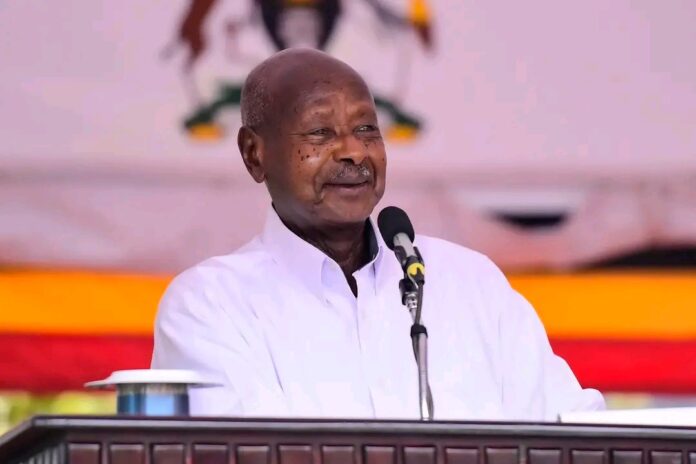

President Yoweri Kaguta Museveni has credited the use of biometric voter verification technology for the National Resistance Movement’s (NRM) decisive victory in Masaka’s recent local council elections, describing the machines as a key tool in curbing electoral malpractice.
Speaking during the just-concluded 2026 Uganda People’s Defence Forces (UPDF) parliamentary elections at Bombo, Museveni said the deployment of Biometric Voter Verification Kits (BVVKs) directly contributed to the NRM winning 43 out of 52 elective positions in Masaka a region long regarded as a political battleground.
“The Biometric Voter Verification System machines were used in Masaka, and NRM got 43 positions out of 52,” Museveni said.
The President went on to claim that electoral fraud had significantly affected previous polls, alleging that opposition-linked groups had infiltrated millions of irregular votes into the system.
“In the last elections, this NUP group infiltrated about 2.7 million fake votes. That is why I insisted on the use of BVVK machines,” Museveni added, noting that the technology was also deployed in Bulambuli, where he said it contributed to the defeat of opposition figures Robert Kyagulanyi (Bobi Wine) and Nathan Nandala Mafabi.
Museveni made the remarks while overseeing the voting process for UPDF parliamentary representatives for the 2026 term.
What are BVVKs?
Biometric Voter Verification Kits were introduced in December 2025 to strengthen voter identification through fingerprint and facial recognition. The technology was designed to prevent multiple voting, impersonation, and other electoral irregularities.
However, their rollout during the January 2026 general elections was marred by technical challenges. Several polling stations experienced delays and system failures, with officials citing connectivity problems linked to government-imposed internet restrictions at the time.
Museveni’s comments have triggered heated debate online, with many Ugandans questioning the effectiveness and selective deployment of the biometric machines. Critics have asked why BVVKs were not consistently used across all electoral processes, particularly during the presidential vote.
Others have urged the Electoral Commission to release detailed Masaka election results to allow for independent verification.
The debate has revived broader concerns about electoral transparency, uniform application of technology, and public confidence in Uganda’s electoral systems.
As pressure mounts, attention is now turning to the Electoral Commission to clarify how biometric systems were deployed and how they performed across different elections.